Supersolids and quantum droplets via light mediated interactions
Introduction
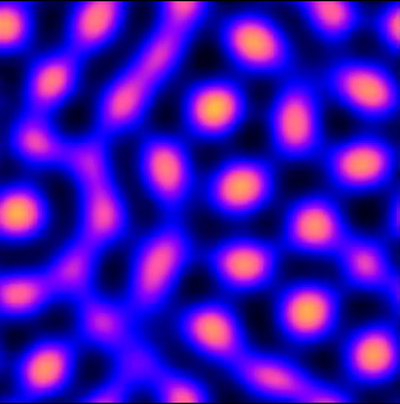
The project aims to realize supersolid and droplet phases of matter in a laser-driven Bose-Einstein condensate of ultracold Cs atoms via light-mediated interactions introduced by feed-back from a retroreflecting mirror. Diffractive dephasing of the retroreflected light induces the nontrivial spatial correlations leading to supersolidity. This work will develop a unique platform for exploring emergent behaviour and symmetry-breaking in self-organised supersolids. We will investigate 1D and 2D supersolids, including those with novel quasiperiodic symmetries. We will study quantum droplets and their connection to solitons. Investigations of persistent temporal dynamics will provide a fruitful connection to the archetypical quantum Hamiltonian Mean Field Model advancing the knowledge of the statistical mechanics of long-range coupled systems and time crystals.
It builds on earlier work on self-organized phases in laser-cooled atomic ensembles and vapour cells in single-mirror feedback setups. For an explanation of how diffraction and the Talbot-effect mediate light-induced interaction between atoms, see the overview and this review.
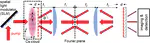
A schematic experimental implementation is shown below. A cloud of Cs atoms is trapped in the shape of a cigar or pancake in a vacuum chamber (dashed black lines). An afocal telescope is used to relay the feedback mirror from outside the vacuum chamber as a virtual mirror close to the cloud (dashed red lines). Expected supersolid structures in 1D are stripes, in 2D hexagons. In the space between the lenses additional elements as spatial filters or image rotating Dove prisms can be introduced to control the properties and symmetry of the crytalline structures, in particular to induce quasi-periodic ones. The spatial light modulator (SLM) will be realized as a liquid crystal on silicon modulator (LCOS-SLM) or a digital mirror device (DMD) depending on switching speed and phase and amplitude smoothness required. This will be used either to seed the stationary ground state of the supersolid directly or an oscillating “quasi-stationary” states which a very long lifetime due to long-range coupling. The apparatus builds on an existing experimental platform for quantum-degenerate ensembles of caesium atoms, used to study lattice physics, nonlinear quantum fluids, and out-of-equilibrium many-body dynamics.

Experimental scheme
Latest News
We seek a motivated postdoctoral researcher to implement an experimental research programme on supersolids and quantum droplets in a laser-driven Bose-Einstein condensate of ultracold caesium atoms via light-mediated interactions introduced by feedback from a retroreflecting mirror.
We are recruiting a Research Associate in Theoretical Physics to work with Drs Kirton and Robb on the theory of the formation of supersolids and droplet structures via light mediated interactions in a BEC.

For the starting EPSRC funded project Supersolids and quantum droplets via light mediated interactions we are looking for two motivated postdoctoral researchers with a start date from February 2026.


Publications informing the project
People

Dinesh Mothsara
MRes student
Dr Elmar Haller
Senior Lecturer
Ethan Kerr
PhD student
Dr Gordon Robb
Reader
Kelsey O'Donnel
PhD student
Dr Peter Kirton
Senior Lecturer
Robbie Cruickshank
PhD student
Prof Thorsten Ackemann
Professor
Funding
- EPSRC: Supersolids and quantum droplets via light mediated interactions (10/2025 - 09/2028, £1M, FEC £1.26M)
